

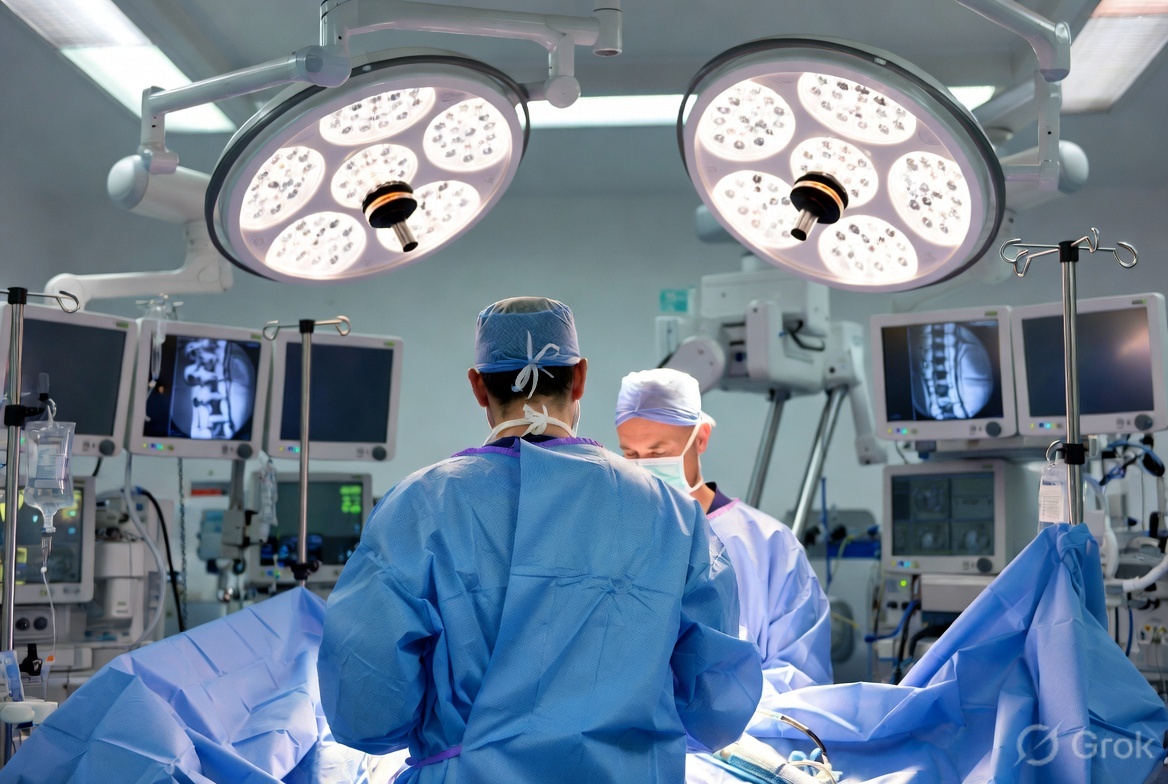
The Sanjay Gandhi Postgraduate Institute of Medical Sciences (SGPGI) in Lucknow has taken another major step toward advanced healthcare innovation with the introduction of the O-Arm imaging system for spine surgeries.
As healthcare institutions across India increasingly adopt AI-driven and image-guided surgical technologies, SGPGI’s latest move reflects the growing emphasis on minimally invasive and precision-based healthcare.
The introduction of the O-Arm system places SGPGI among a select group of Indian medical institutions equipped with advanced intraoperative 3D imaging technology for spinal procedures.
What Is the O-Arm System?
The O-Arm system is an advanced intraoperative imaging platform used primarily in spine and neurosurgical procedures. Unlike traditional imaging systems, the O-Arm provides surgeons with real-time 2D and 3D imaging during surgery itself.
The system creates high-resolution images that allow surgeons to navigate complex spinal anatomy with greater accuracy. It is especially valuable in procedures involving:
- Spinal deformity correction
- Spinal fusion surgery
- Minimally invasive spine procedures
- Tumor removal
- Trauma surgeries
- Implant placement
The technology works alongside surgical navigation systems, enabling doctors to visualize the exact position of surgical instruments and implants during the operation.
This real-time guidance reduces the chances of errors and enhances overall surgical precision.
Why the O-Arm System Matters
Spinal surgeries are among the most delicate and technically demanding procedures in modern medicine. Even small inaccuracies in implant positioning or navigation can lead to serious complications.
Traditional surgical imaging methods often rely on preoperative scans or limited intraoperative imaging. However, patient positioning during surgery can alter anatomy slightly, creating challenges for surgeons.
The O-Arm addresses this problem by delivering live 3D imaging during the procedure itself.
This offers several important advantages:
Enhanced Surgical Precision
The system allows surgeons to accurately place screws, implants, and instruments with greater confidence. Real-time visualization minimizes the risk of misplacement during spinal fixation procedures.
Improved Patient Safety
Accurate imaging reduces complications associated with nerve damage, incorrect implant placement, or repeat surgeries.
Better Outcomes in Complex Cases
Patients with severe spinal deformities, trauma injuries, or complex anatomical conditions benefit significantly from image-guided surgical navigation.
Support for Minimally Invasive Surgery
Minimally invasive spine procedures require high precision because surgeons operate through smaller incisions with limited direct visibility. The O-Arm helps overcome these limitations.
Reduced Revision Surgeries
Improved implant accuracy lowers the need for corrective surgeries, reducing recovery time and healthcare costs.
SGPGI’s Growing Focus on Advanced Healthcare Technology
The addition of the O-Arm system is part of SGPGI’s broader strategy to modernize healthcare delivery through advanced medical technologies.
Over the past few years, the Lucknow-based institute has introduced several advanced systems across multiple specialties.
Recent upgrades include:
- AI-enabled cardiac imaging systems
- Advanced trauma radiology equipment
- Robotic surgical systems
- Advanced hearing assessment technologies
- High-resolution ultrasound systems
- Digital imaging infrastructure
These developments highlight SGPGI’s increasing focus on precision medicine and technology-driven healthcare.
The institute has also emerged as a major center for robotic and minimally invasive surgeries in North India.
By adopting technologies such as the O-Arm, SGPGI aims to improve healthcare accessibility while offering advanced treatment options comparable to leading national and international hospitals.
The Rise of Image-Guided Spine Surgery
The global healthcare industry is witnessing rapid adoption of image-guided surgical technologies.
Traditionally, surgeons relied heavily on anatomical landmarks and fluoroscopy during spine surgeries. While effective, these methods had limitations in accuracy and radiation exposure.
Modern technologies like the O-Arm are changing this landscape.
Image-guided surgery combines advanced imaging with computerized navigation systems to create a highly precise surgical environment.
This trend is particularly important because spinal disorders are becoming increasingly common due to:
- Aging populations
- Sedentary lifestyles
- Road accidents
- Degenerative spinal conditions
- Rising obesity rates
As patient demand for safer and less invasive procedures grows, hospitals are investing heavily in advanced surgical imaging systems.
The introduction of the O-Arm at SGPGI reflects India’s broader transition toward technologically advanced healthcare infrastructure.
Benefits for Patients
The biggest impact of the O-Arm system will ultimately be seen in patient care and recovery outcomes.
Smaller Incisions and Faster Recovery
Minimally invasive procedures supported by advanced imaging often require smaller incisions, leading to:
- Reduced blood loss
- Lower infection risk
- Faster recovery
- Less postoperative pain
Increased Accuracy
Precise implant positioning improves surgical success rates and long-term spinal stability.
Reduced Radiation Exposure
Advanced navigation systems can reduce repeated imaging requirements during surgery, lowering radiation exposure for both patients and surgical teams.
Better Outcomes in High-Risk Cases
Patients with spinal tumors, deformities, or trauma injuries often require highly accurate surgical interventions. Real-time imaging significantly improves confidence in these procedures.
India’s Growing Investment in MedTech Infrastructure
Healthcare institutions across India are increasingly investing in advanced medical technologies to bridge the gap between global healthcare standards and domestic patient care.
Government-supported institutes like SGPGI are becoming important centers for medical innovation.
The rise of technologies such as:
- Robotic surgery
- AI-assisted diagnostics
- Image-guided surgery
- Smart operating rooms
- Precision imaging systems
is transforming healthcare delivery across the country.
These investments are particularly important in public healthcare institutions, where access to advanced treatments was previously limited.
SGPGI’s adoption of the O-Arm system demonstrates how Indian healthcare institutions are moving toward globally competitive standards in specialized surgeries.
Challenges That Still Exist
While advanced technologies offer major benefits, there are still challenges associated with implementation.
High Infrastructure Costs
Systems like the O-Arm require significant financial investment, making them difficult for smaller hospitals to adopt.
Training Requirements
Surgeons and operating room teams require specialized training to effectively use advanced imaging and navigation systems.
Accessibility Gaps
Advanced healthcare technologies remain concentrated in large urban hospitals, limiting access for patients in rural and smaller cities.
Operational Complexity
Maintaining sophisticated imaging systems requires ongoing technical support and infrastructure upgrades.
Despite these challenges, the long-term benefits often outweigh the initial investment.
The Future of Spine Surgery in India
The introduction of technologies like the O-Arm signals a major shift in the future of surgical care in India.
Future spine surgeries are expected to become:
- More minimally invasive
- AI-assisted
- Navigation-driven
- Personalized
- Precision-focused
Hospitals are increasingly integrating imaging, robotics, and AI to improve patient outcomes while reducing surgical risks.
As healthcare technology continues evolving, image-guided surgery may eventually become the standard approach for many complex procedures.
Institutions like SGPGI are helping accelerate this transformation by adopting next-generation surgical systems and improving access to advanced care in India.
Conclusion
The introduction of the O-Arm system at SGPGI Lucknow marks an important advancement in India’s healthcare technology landscape. By bringing real-time 3D imaging and navigation capabilities into spinal surgeries, the institute is improving precision, safety, and treatment outcomes for patients requiring complex spinal procedures.
More importantly, this development reflects the broader transformation taking place across India’s healthcare ecosystem, where advanced imaging, robotics, and AI-powered systems are reshaping modern medicine.
As patient expectations evolve and demand for minimally invasive procedures grows, technologies like the O-Arm will likely play a central role in the future of spine surgery and precision healthcare in India.